Wednesday, 30 May 2007

A different way of thinking about art...


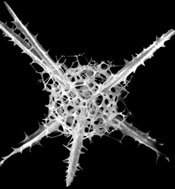
I have finally read through the blog - just in time for the last meeting! (Spending a lot of my working day in front of a computer I find it a bit hard to do the same when I get home...) I was really excited when I heard about this project as I have a long-held interest in where art and science meet. I've been entranced by images of microscopic organisms like these from D'Arcy Thompson's On Growth and Form (first published in 1917) for years. However, what is really interesting to me is Abigail's "conceptual" approach to art. I have always painted and created things but just because I find them pleasing - not because they really mean anything.
It is going to be a real challenge to create a sculpture which can convey the Jurassic Coast in terms of physical space, time and biodiversity! I believe that it will alter people's perception of what they are walking on when they come to Durlston - and anything that makes us think has to be a good thing.

Sunday, 27 May 2007

Friday night on the Bournemouth Belle

Friday25th May was a calm and pleasant evening perfect for a boat trip to view the Durlston Coast. We set off from Swanage and travelled along to Old Harry then back along the coast to Dancing Ledge. The rock formations were fantastic. All that we had learnt from working with Sam really helped us to appreciate what we were looking at. Robin senior ranger from Durlston Country park gave us a very informative commentary not just on the birdlife but on the structures of the cliffs and the history of their formation. There is a horizontal fault that runs from Durlston all the way along the coast. This is known as the Puffin Ledge but the Puffins were in hiding on Friday night!! We have walked the Dorset Coastal Path many times over the past 35 plus years blissfully unaware of the cliffs and rock formations under our feet, a walk in Durlston park will never be the same again

Wednesday, 23 May 2007

Rain and radiolaria


Sam is with two of her post doc students today. They have collectively been working on the data to produce a set of fabulous graphs. We pore over these for a couple of hours as they aren't easy yet to comprehend. I can see some problems with translating them into three dimensions but I'll ask Bjorn the mathematician to think about this. He's in America but still in touch.
A wet day with low visibility, but the group all arrive - many of them bringing unwanted bits of stuff from their garage... This is great but I am still worried - less than a month to go before we begin to build the sculpture now. We create more 'radiolaria' from porcelain clay. We have a pile of twenty of these shapes now... but i'd like at least two hundred. Another logistical issue to overcome.
In the drizzle we walk down to Tilly Whim caves and observe the different layers of rock formation, some massive, others that look as if they have been built from bricks. The caves aren't worked now, but clearly exploit the massive formations. it is low tide, the sea has itself exploited the weaknesses in the rock, this 'dirty' limestone, full of imperfections, to slice off sections at ninety degrees. We see a woodpecker in the valley by the lighthouse. It's not a river valley but was carved out by meltwater when the glaciers receded, just like the sharp cut though the ridge where Corfe Castle was strategically built.
I also make some tests with the plastic bottles we've collected. I can't get a convincing way to join and pack them. I'll probably have to ditch them as a potential material, which is shame as they are so easy to source.

Monday, 21 May 2007

Peveril Point - Searching for Microfossils!


What an enjoyable evening I had searching for fossils on Peveril Point - who would believe you could get so excited by the discovery of minute beany looking microfossils in a flaky piece of rock. A real eye opener! I forget all the specialized names now but to me thats not really important its the fact that these fossils are millions of years old and you can see them here on Peveril Point so easily and actually with the naked eye if you look really carefully.

What was also amazing was the identification of fish scales - they would appear on the surface of the rock as jet black gems - smooth and shiny - and passing your finger over them you could feel how they were raised slightly above the rock - very beautiful formations - quite unbelievable really.

Another favourite for me is the layers of rock that can be seen in the cliff face and how one can see the force of movement - where different strata have shifted to create a visible fold.

The variation in the rock that has fallen at Peveril Point is wonderful there are huge chunks that have broken away to reveal bands of protruding fossilized shells that feel rough to the touch.

Sunday, 20 May 2007

Saturday 19th May - walking the coast


I was disappointed that the first boast trip of the season was cancelled but we ended up staying Dorset anyway and made the most of the beautiful, but windy, Saturday morning by heading out with my boyfriend Gary to Kimmeridge Bay. By this time my student Clara Bolton and I had produced the Dorset diversity plot and it really has added a new dimension to the walking up and down the topography of the cliffs and thinking about the biodiversity under foot. There were amazing views west along the geological succession from the organic-rich clays (rich in dinoflagellates) through limestones and shales to the chalk cliffs towards Lulworth in the distance. We could also just about make out Portland on the horizon. To the east we walk along the Kimmeridge Clay and up the Jurassic succession. On the way back we picked up a few fragments of the dark, organic rich shales of the Kimmeridge units and bivalve mollusks as well as lots of ammonite fragments are obvious on the surfaces as delicate imprints. No chance of seeing microfossils with a hand lens in these rocks but they are there in abundance!

Biodiversity

Abigail and I have spent much time discussing how the plankton that lived in the Jurassic and Cretaceous of Dorset changed through time as part of our conversations on the dynamic nature of the landscape, the geology, and the organisms recorded in the rocks. The species found change in two main ways. First, there is the evolution of species within each microfossil group that is driven by climatic change, habitat space, and natural variability. Species appear while others either evolve into new species or become extinct. Second, the collection of species we find associated at each time interval and at each location is a product of the ecological tolerances of each species. With changes in environmental conditions we get variation in the species found. Individual species have different tolerances to temperature, food availability, water depth, salinity, etc. Tying this back to Durlston and the Isle of Purbeck, we know there are huge variations in environmental conditions, mainly resulting from sea-level changes, with deep oceans through to river systems recorded in the rocks. This results in huge variations in the assemblages of species found which is superimposed on the evolution of individual species through time. Through really useful chats with fellow micropalaeontologists, we’ve now got access to a superb dataset published in 1987 under the editorial supervision of Alan Lord and Paul Bown of University College London. It lists all the microfossil species found in a set of samples that were collected along the Dorset coastline. There are about 120 samples and it provides us with a unique record of the variation in diversity of microfossil with variation in environmental conditions through the Jurassic, Cretaceous and into the Paleogene. We intend to collate this data and produce diversity curves which we can then compare with records of sea-level change and temperature change. This will give us the opportunity to produce plots of data that are directly relevant to Durlston.

Sunday afternoon - The compiled data has produced a beautiful plot! As expected, diversity is relatively low where sea-level was low and freshwater, brackish or lagoonal conditions dominated. The highest diversities correspond to the Cretaceous chalk where a high diversity of plankton existed in warm, extensive shelf seas. So, the Wealden beds of Swanage bay are represented by a diversity low and then as we move towards Ballard Down diversity steeply increases and mimics the topographic high of the down. The dataset gives us a neat picture of diversity changes as we walk along the coast from Lyme Regis to Bournemouth. We’ll look in detail at this plot at the next meeting on Monday.

Drawings


May 17th

Back at Durlston I visit the household recycling center in the van. I've been OK'd by Dorset CC to take as much stuff as I like for the project. I load up but it's going to be very hard to get enough material like this, as it's a 20mile round trip and we need a huge amount.

In the 'studio' I pin up a series of drawings that I have made over the past week. The drawings are very abstract - bunches and layers of repetitive shapes that swirl into one another. I made them as a way to try and think about how to get small shapes to dynamically make bigger shapes, which contribute to even larger scale shapes. That's all.

Sam has, amazingly, discovered a study made in 1987 on the whole Jurassic coastline east from beyond Swanage along west to Pinhay in Devon. At regular intervals rock samples were collected and the microfossil content logged. There's no analysis, no graphing, just a list of what was found. This is an amazing find - we can base all our analysis on this unused, twenty-year old data set.

The group arrive bang on time in the studio and after some discussion - partly about how to contribute to a blog site - we head down to the beach at Peveril Point armed with some hand lenses and Sam's book. It's an warm clear evening and the Isle of Wight is sharply delineated on the horizon as we spend a happy hour identifying ostrocods and different types of bivalve. You can't move for fossils.

Two group members spontaneously and independently say that the fossilised shells embedded in the rocks look like the drawings I have pinned up in the studio, which is curiously satisfying, as I hadn't somehow made that obvious connection myself.